
Turkish Scientists Discover a New Cell Type in the Thyroid Gland: A Major Discovery After 150 Years
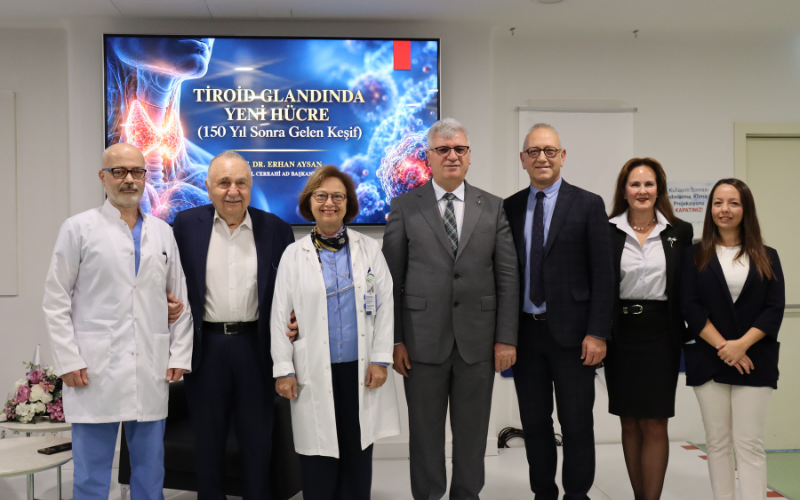
A discovery by Turkish scientists is changing a fundamental fact that has appeared in medical textbooks for nearly 150 years. Prof. Dr. Erhan Ayşan of Yeditepe University’s Division of Endocrine Surgery and the research team have identified a new type of parathyroid hormone-secreting cell in the thyroid gland, a finding set to challenge established understanding in medical literature worldwide. The discovery also provides a scientific explanation for previously unexplained low parathyroid hormone levels after thyroid surgery and for why hormone levels do not fall to zero even after all parathyroid glands have been removed. It is also expected to bring major changes in areas ranging from thyroid surgery to early diagnosis and new treatment approaches for thyroid diseases.
Prof. Dr. Erhan Ayşan, an endocrine surgeon at Yeditepe University, said the discovery goes beyond identifying a new cell: “Basic physiology and histology textbooks state that ‘Parathyroid hormone is secreted only by the parathyroid glands.’ We have identified a new group of cells within the thyroid gland that secrete parathyroid hormone and have successfully imaged these cells. This discovery changes one of the fundamental facts taught in medical education.”
Fundamental knowledge is changing after 150 years
Ayşan said that, until now, the thyroid gland was understood to contain only two cell types. Medical school textbooks describe follicular cells, which secrete T3 and T4, and parafollicular cells, which were discovered about 150 years ago. Ayşan said the new study had identified a third cell type within thyroid tissue: “Until now, parathyroid hormone was understood to be secreted only by chief cells in the parathyroid glands. Our study has shown that the thyroid gland can also produce parathyroid hormone. We have therefore identified a new cell type and changed the fundamental understanding that parathyroid hormone is secreted only by the parathyroid glands.”
The discovery answers many questions in thyroid surgery
According to Ayşan, the discovery has theoretical implications and important consequences for clinical practice: “Some patients experienced a drop in parathyroid hormone levels after successful thyroid surgery even though their parathyroid glands had been left in place. For years, the reason could not be fully explained. We now know that the true cause is the removal of these new cells within the thyroid gland along with the thyroid tissue.”
Ayşan said the discovery also explains why parathyroid hormone levels do not fall completely to zero in patients who have had all their parathyroid glands removed: “After these operations, we surgeons would repeatedly wonder whether we had missed something during the patient’s surgery. Our study shows that parathyroid hormone secreted by thyroid tissue provides a very clear explanation for this.”
A new era in thyroid surgery could begin
Ayşan said the discovery could prompt discussion of a new decision-making algorithm for thyroid surgery in the coming years and that organ-preserving thyroid surgery would become more important. “As surgeons, we will now have to think more carefully about removing the entire thyroid gland. For some patients, thyroid-sparing surgery that leaves healthy parts of the gland in the body may be preferable to removing the entire gland. This approach will greatly improve our patients’ quality of life by minimizing the impact on natural hormone secretion,” Ayşan said.
Medical school textbooks could be rewritten
Ayşan said the discovery would bring changes to the basic medical sciences: “The statement in physiology and histology textbooks that ‘Parathyroid hormone is secreted only by the parathyroid glands’ will now have to be updated. The discovery of a new cell is a very rare event in the history of science. After nearly a century and a half, fundamental knowledge about the thyroid gland is changing.”
The discovery could enable early diagnosis and new treatments
Ayşan said the discovery would be the starting point for many studies investigating the role of these cells, particularly in thyroid cancers, as well as in Hashimoto’s disease, Graves’ disease, and thyroiditis. “Once we establish which diseases are associated with an increase or decrease in the number of these cells, the findings could be used to develop methods for early diagnosis and could lead to new treatment options. It is difficult to predict what research in these areas will bring. The tower of science rises slowly, one small brick at a time. As studies are conducted and results emerge, we will all see how the picture develops,” Ayşan said.
The discovery is the result of years of work by a multidisciplinary team
Ayşan said this important discovery was the result of many years of work by a large research team, rather than an individual achievement: “Science and technology have advanced greatly, and the amount of knowledge has grown enormously. It is impossible for one person to master so much knowledge and make a substantial contribution to scientific understanding. We recognize this. That is why we have a large research group spanning the basic sciences, engineering sciences, and clinical sciences, whose members have worked together for years. So far, we have published many scientific papers on the thyroid and parathyroid glands and obtained many patents. If you look at major scientific discoveries today, they are always the work of large, multidisciplinary teams rather than individuals. Our discovery is no different. Today, we share this pride as a team, rather than as individuals. Every researcher on our team has put at least as much effort into this work as I have. We could never have reached this point without coming together and working as a team.”
What will this discovery change?
- The thyroid gland is not limited to secreting T3, T4, and calcitonin.
- Parathyroid hormone is not secreted exclusively by the parathyroid glands.
- Organ-preserving approaches will be used more frequently in thyroid surgery, improving patients’ quality of life after surgery.
- The cause of low parathyroid hormone levels after thyroid surgery has been explained.
- The reason why blood parathyroid hormone levels do not fall to zero in patients whose parathyroid glands have all been removed has been explained.
- A new era could begin in the diagnosis and treatment of common thyroid diseases such as thyroid cancers, Hashimoto’s disease, and Graves’ disease.
- New biomarkers for early diagnosis could be developed.
Press: CNN Türk | Cumhuriyet | Aydınlık | DHA